A document, or a canvas
How a well-designed CV can become invisible, and how to avoid it.
How a well-designed CV can become invisible, and how to avoid it.
It was a passing remark. The CV was one I had designed myself, and I liked it.
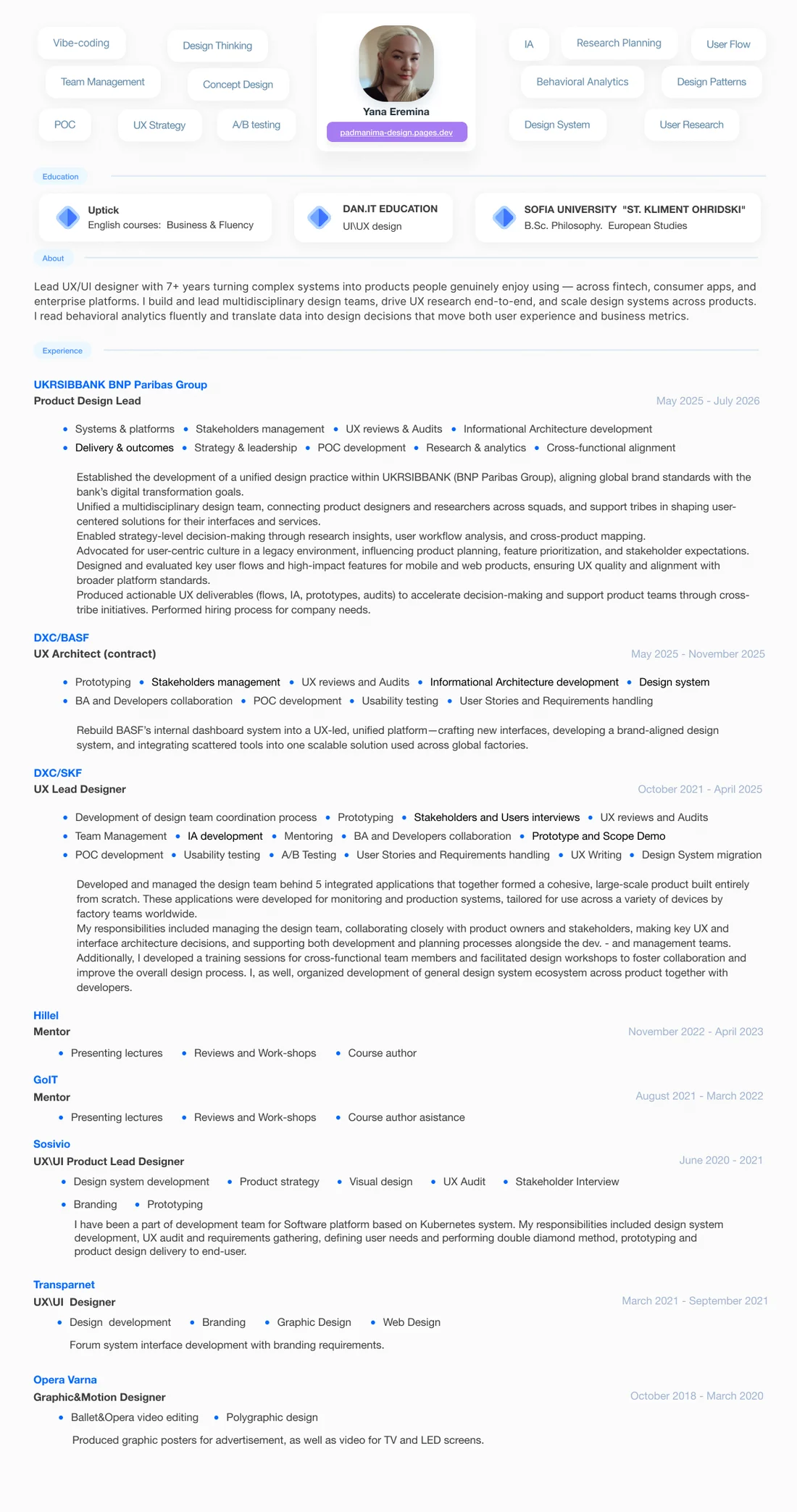
Card layout, clear hierarchy, skill tags around a photo. People who read it said good things about it. So I did what I would do with any product that seemed fine but wasn't: I measured it.
Often, though not always, software reads a CV before a person does: it turns the file into plain text, and search, matching and ranking happen on that text. I ran my file through three common PDF text readers, the kind that sit inside recruitment systems, and read what came out.
Every reader started with my skill tags. To me they were a decorative cluster around the photo. To software they were simply the first things drawn on the page, so they were the first things read. Pick a reader to see what it made of the file. The number is how many of 23 checks it passed: my name, my email and website, every employer, job title and date, and every school.
The first lines it read
SK F, and the same happened to
D XCand
Sosi v io. Three and a half years at SKF became invisible to search, along with that job title (
U X Lead Designer) and its dates (
Octo b er 202 1).
S O F IA UNI V ERSI T Y,
DAN . I Tand
Uptic k. No search would match any of them.
13 of 23 checks
The first lines it read
Vibe-coding.
Sosiviois followed by
Presenting lecturesand
Course author, which were my duties at GoIT. Sosivio's own job title ended up further up, among other roles' dates.
22 of 23 checks
The first lines it read
BASF’scame out as
BASFˇs, and a dash became an invisible control character.
22 of 23 checks
The first lines every reader read
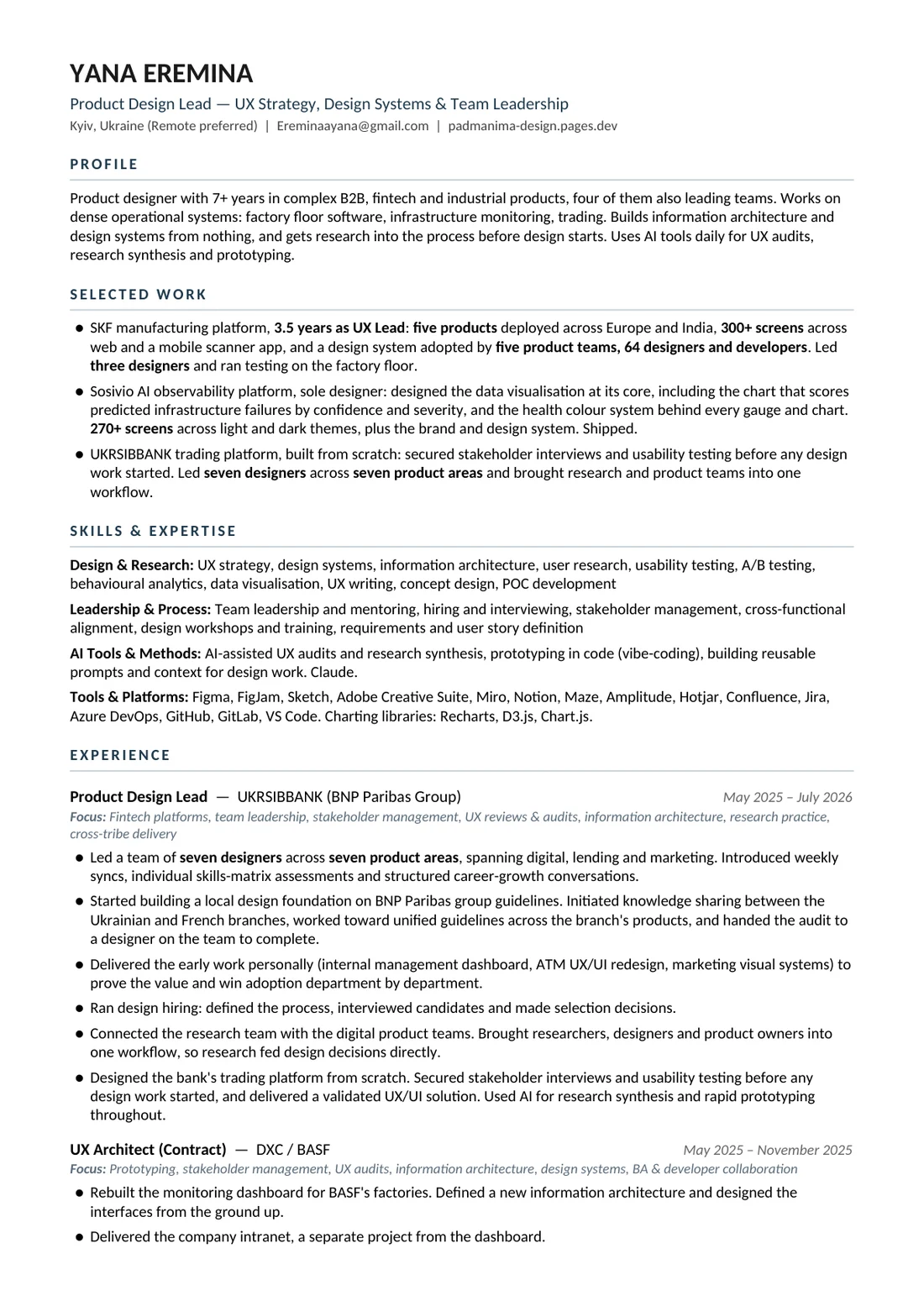
23 of 23 checks, in every reader
One miss was mine alone: my email wasn't in the old file at all, only a link to this website. No reader can find what isn't there.
The failure wasn't total, which is why I had never noticed it.
My most recent role came out perfectly in every reader: UKRSIBBANK BNP Paribas Group, Product Design Lead, May 2025 - July 2026
. If I had checked the top of the text, I would have decided everything was fine.
The damage was further down, in the roles nobody scrolls to. Read the end, not just the beginning became the most useful rule of the whole exercise, and it turned out to be true of the writing as well as the file.
| Before | After | |
|---|---|---|
| File size | 6.3 MB | 74 KB |
| Page | One page, 595 × 1129 pt (A4 is 595 × 842) | Two A4 pages |
| Fonts | 5 Type 3 fonts, none of them named | 4 named TrueType fonts |
| Images | 22 | 0 |
| Email in the file | No | Yes |
| Checks passed, worst reader | 13 of 23 | 23 of 23 |
Type 3 fonts draw each letter as a shape instead of setting it as text in a known typeface. That is how Uptick
comes apart into Uptic k
.
1129 points tall, where A4 is 842. A continuous canvas, the way a web page is continuous. Nothing downstream expects that.
Cards, tags and photo were positioned on the canvas, so the text came out in the order things were drawn, not the order they should be read.
My first thought was that designers have to give up and make plain CVs. Most articles on this reach the same conclusion.
The evidence says otherwise. My rebuilt CV has bold text, bullets, coloured headings and spaced-out section titles, and all three readers read it whole. Standard headings even help, because they tell software which part it is reading.
The line runs somewhere else. A designed CV built as a document is read correctly. A CV exported from a design canvas is a picture with text drawn on top, and how good the picture is makes no difference.
A document, or a canvas.
My design was fine. My export path was the problem.
Once the file worked, I went back to the words and gave each role about fifteen seconds, the way someone with a hundred applications would.
An earlier version opened my most recent role with this sentence:
Launched a unified design practice with no dedicated design budget or headcount.
I wrote it to show what I had achieved against real constraints, and I was proud of it. Skimmed, it says something else: no headcount. I had led seven designers at the bank and three at SKF, and the first line of my latest job suggested I had led nobody.
Having found the leadership problem, I answered it so thoroughly that the CV turned into a management CV with design work attached at the back. I caught it by counting words again: screens
, the thing I actually make, had almost disappeared. Measuring caught what my sense of the change missed.
I worked with AI assistance throughout, and at one point the profile ended …while keeping the judgement about what is good firmly human
. Nobody writes that about themselves. In a CV that claims AI fluency, it was the worst place for that cadence. I cut it, along with a run of bullets that all had exactly the same shape.
300+ screens
says how much work I did. A design system adopted by five product teams, 64 designers and developers
says what changed because I did it. I had the second number in my head the whole time.
Deployed across Europe and India
replaced deployed worldwide
. Everybody writes worldwide. The smaller claim is the one people believe.
I had a before-and-after sentence for every employer. One at a time they read as achievement. Four in a row read as someone who talks about her employers.
When most bullets carry bold text, bold stops meaning anything, and the bullets without it look demoted by accident. I picked one rule for it and kept to it.
A CV reader is a user who can't see.
It can't see layout, colour, hierarchy or composition. It reads in one order and takes what it is given. Designers are asked to make products work for people in exactly that position: contrast, structure, screen readers, reading order. I have argued for that work in front of people who didn't want to pay for it.
Then I built the one document that represents me so that the first thing reading it couldn't see it either. That makes it an accessibility problem, in the one place I never thought to look.
A skill for Claude, called cv-builder, so I wouldn't have to work this out twice.
It diagnoses an existing CV or builds one from nothing, and it checks the file before anyone reads a word of it. It also keeps what is mechanically true about screening apart from the folklore around it. Most of the advice I found while researching this was wrong, and wrong advice makes people write worse CVs.
If your CV might be doing this, the check takes about ten minutes. I'm happy to look.
How this was measured: the original and the rebuilt CV were read with three open-source PDF text readers, pypdf 6.20, pdfminer.six 20260107 and PyMuPDF 1.28, standing in for the readers inside recruitment systems. The 23 checks are my name, email, website, every employer, job title and date range, and every school. Each reader's output is quoted exactly as it came out.